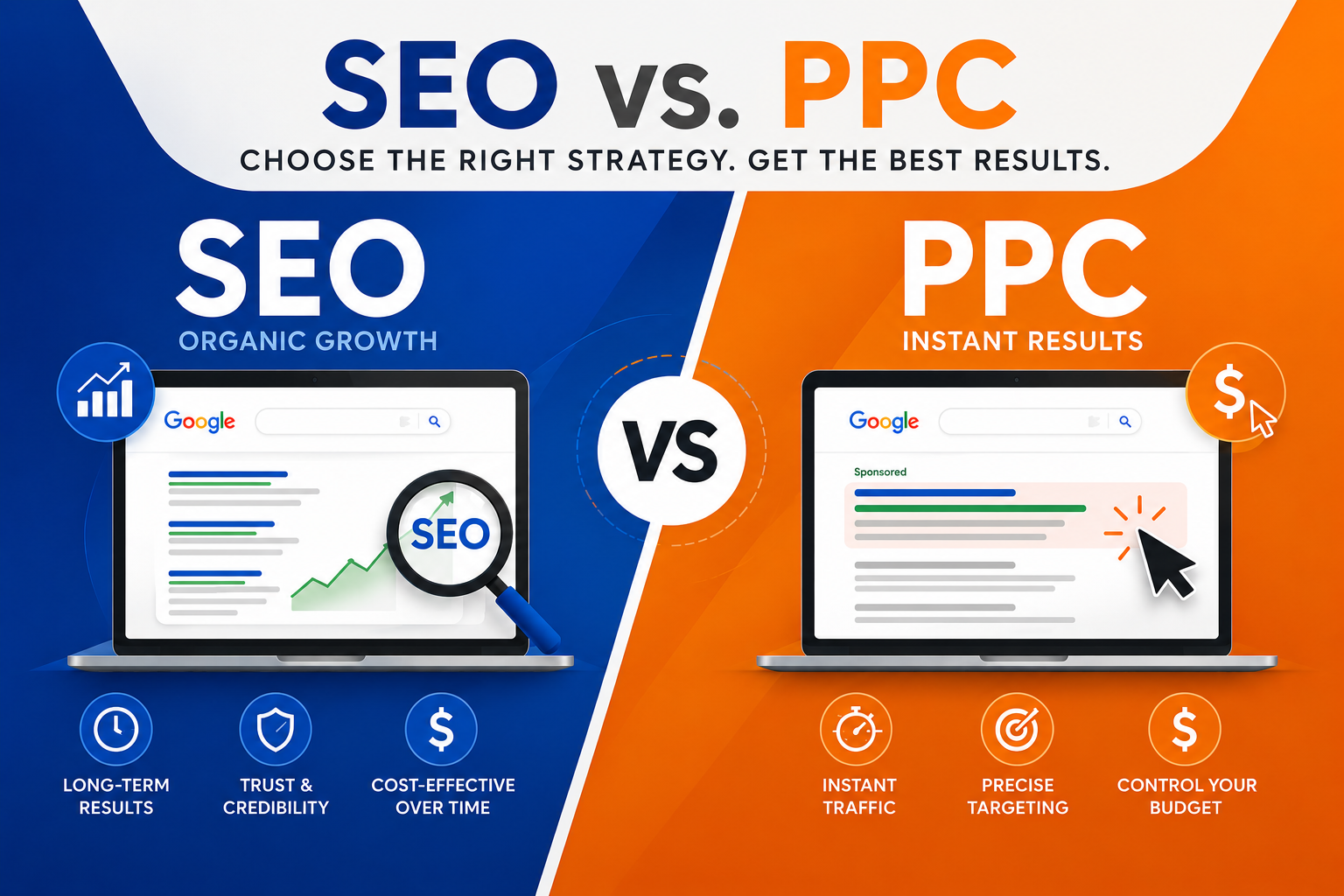
Every business owner in Texas, from a family-run restaurant in Sachse to a growing law firm in Dallas, eventually asks the same question: SEO vs. PPC — which marketing strategy is right for my business? Both strategies can bring customers to your website, but they work in very different ways, move at different speeds, and fit different budgets and goals.
If you are trying to decide where to put your marketing dollars this year, this guide breaks down exactly what SEO and PPC are, how they work for Texas businesses specifically, and how to choose the right approach (or combination of both) for your company. At Detral, we work with Texas businesses every day to help them figure out exactly this, so let’s break it down.
What Is SEO?
SEO, or search engine optimization, is the process of improving your website so it ranks higher in organic (unpaid) search results on Google. When someone in Houston searches “best HVAC company near me” or a Fort Worth shopper looks up “custom furniture Texas,” SEO determines whether your business shows up on page one or gets buried on page five.
Good SEO for a Texas business typically includes:
- Clear, helpful website content written for real people, not just search engines. Local keywords that reflect how Texans actually search, such as “Dallas plumber” or “San Antonio wedding photographer” instead of generic national terms. A well-organized site structure with fast load times and mobile-friendly design, since most local searches happen on phones. Google Business Profile optimization, which is critical for the “map pack” results Texas customers see for local searches. Backlinks and citations from trusted Texas directories, chambers of commerce, and local news outlets.
There is no cost to appear in organic search results, and once your site starts ranking well, that visibility tends to compound over time. The tradeoff is patience: SEO is a long-term strategy, and most businesses see meaningful movement over several months rather than days.
What Is PPC, and When Should You Use It?
PPC, or pay-per-click advertising, is how businesses buy visibility instead of earning it organically. With platforms like Google Ads, you bid on keywords so your ad appears above or alongside organic results. You only pay when someone actually clicks your ad.
For Texas businesses, PPC is especially useful when:
- You are launching a new business or location and need visibility immediately, without waiting for organic rankings to build. You are running a seasonal promotion, like a summer AC tune-up special or a back-to-school sale, and need traffic right now. You want to target a very specific Texas metro, zip code, or radius around your storefront. You are testing which keywords or offers actually convert before committing to a bigger long-term SEO strategy.
PPC also extends beyond the search results page. Through the Google Display Network, Texas businesses can place ads on thousands of relevant websites their customers already visit, expanding reach well beyond a single search query.
One important thing to understand: PPC spend does not improve your organic rankings. Google keeps paid and organic results separate specifically so that businesses cannot pay their way to better SEO. The two systems influence visibility independently.
SEO vs. PPC: Key Differences at a Glance
| Factor | SEO | PPC |
| Cost | No direct cost per click; investment is time and content | Pay per click; costs scale with competition |
| Speed | Takes months to build momentum | Traffic can start the same day |
| Longevity | Results compound and persist over time | Traffic stops when the budget stops |
| Best for | Long-term brand visibility and trust | Immediate leads, promotions, testing |
| Control | Limited control over exact placement | Precise control over targeting and budget |
Why Texas Businesses Need a Localized Strategy
Texas is not one market, it is dozens of them. A search strategy that works in Austin’s tech-driven, highly competitive market will not necessarily work in a smaller city like Sachse, Plano, or Waco. This is where a lot of generic marketing advice falls short for Texas business owners.
A few things make Texas unique for local search:
- Texas has some of the fastest-growing metro areas in the country, meaning search competition is intensifying every year, especially around Dallas-Fort Worth, Houston, Austin, and San Antonio. Suburban and smaller-city businesses (like those in Sachse, Wylie, or Rockwall) can often outrank bigger city competitors for hyper-local searches if their SEO is done correctly. Texans searching on mobile devices frequently use voice search and conversational phrases, such as “who has the best tacos open right now near me,” which matters for both traditional SEO and newer AI-driven search experiences.
How AI Search Is Changing the SEO vs. PPC Conversation
Search itself is evolving. Tools like Google’s AI Overviews and other generative AI search experiences are increasingly answering questions directly, sometimes without the user ever clicking through to a website. This shift makes two things more important than ever for Texas businesses:
- Generative Engine Optimization (GEO): Structuring your content so AI tools can easily understand, summarize, and cite your business when answering user questions. This means clear headings, direct answers to common questions, and well-organized information, not just keyword stuffing.
- Answer Engine Optimization (AIO): Writing content that directly and concisely answers the exact questions your Texas customers are asking, since AI-driven results tend to favor content that answers a question in the first sentence or two, then expands with detail.
Both GEO and AIO work hand-in-hand with traditional SEO. A well-structured, genuinely helpful website earns visibility across classic search results, map packs, and AI-generated answers alike. PPC, meanwhile, remains a paid shortcut that sits alongside all of this, useful for immediate visibility but not a substitute for building this kind of long-term authority.
Do You Need SEO or PPC? Ask Yourself These Questions
Rather than framing this as “SEO vs. PPC,” most successful Texas businesses eventually treat it as “SEO and PPC,” using each where it makes the most sense.
Choose PPC first if:
- You need customers this week, not this quarter. You are opening a new Texas location and have zero online visibility yet. You have a limited-time offer or seasonal service. You want to test messaging and keywords before investing heavily in content.
Choose SEO first if:
- You are building a business meant to last for years, not months. You want to reduce long-term dependence on paid ad spend. Your industry has high-value, evergreen searches (like “family dentist Dallas” or “roof repair Fort Worth”) that people search year-round. You want to build trust and authority that compounds over time.
Use both together if:
- You want PPC to generate leads now while SEO builds in the background. You want to use PPC data (which keywords convert best) to inform your SEO content strategy. You are in a competitive Texas market where organic rankings alone will take too long to move the needle.
A Simple Framework for Texas Business Owners
- Start with a clear goal: immediate leads, long-term visibility, or both.
- If budget allows, run both simultaneously and let PPC data guide your SEO keyword targeting.
- Optimize your Google Business Profile regardless of which strategy you lean toward, since it affects both organic map rankings and how PPC ads display locally.
- Revisit your strategy every quarter. As your Texas market matures, the right mix of SEO and PPC often shifts.
Final Thoughts
There is no universal right answer to “SEO vs. PPC” for Texas businesses, because the right strategy depends on your timeline, budget, competition, and goals. SEO builds a durable foundation that keeps paying off long after the work is done. PPC delivers speed and precision when you need results now. The businesses that grow fastest in competitive Texas markets are usually the ones that understand how to use both together, rather than treating them as competing choices.
If you are not sure where your business stands or which strategy makes sense for your budget, working with a marketing team that understands both search engine optimization and paid advertising, and understands the Texas market specifically, can help you avoid wasted spend and build a strategy that actually fits your goals. That’s exactly the kind of work Detral does for Texas businesses, combining SEO, PPC, and modern AI-search optimization into one strategy tailored to your goals and budget.
Frequently Asked Questions
1. Is SEO or PPC better for a small business in Texas?
It depends on your timeline and budget. If you need customers quickly, PPC delivers faster results. If you are building for the long term and want to reduce ongoing ad costs, SEO is the stronger investment. Many small Texas businesses start with PPC for quick wins while building SEO in the background.
2. How long does SEO take to show results for a Texas business?
Most businesses start seeing meaningful movement in rankings within three to six months, though this varies based on your industry, local competition, and how established your website already is. Highly competitive markets like Austin or Dallas may take longer than smaller Texas cities.
3. Does running PPC ads help improve my SEO rankings?
No. Google keeps paid and organic rankings completely separate, so PPC spend does not directly boost your organic search position. However, PPC data can indirectly inform your SEO strategy by showing which keywords and offers actually convert.
4. How much should a Texas business budget for PPC advertising?
Budgets vary widely based on industry and competition, with local service businesses often starting with a modest monthly budget and adjusting based on cost-per-click and conversion data in their specific city or metro area. It’s best to start with a test budget and scale up once you see which campaigns perform.
5. What is GEO and AIO, and why do they matter for Texas businesses now?
GEO (generative engine optimization) and AIO (answer engine optimization) refer to structuring your website content so that AI-powered search tools, like Google’s AI Overviews, can easily understand and reference your business when answering user questions. As more Texans use AI-assisted search, businesses that optimize for these tools alongside traditional SEO gain visibility even when users never click through to a traditional list of search results. Detral builds this kind of forward-looking optimization into every SEO strategy for its Texas clients